
ABOUT ORNITHOPTERS
 
 Introduction
 Ornithopter Society
 Online Store

BUILD & FLY
 
 Getting Started
 Simple Experiments
 Competition Info
 Design Your Own

MEDIA
 
 What's Been Done
 Articles & Plans
 Video Clips
 Software

RESOURCES
 
 Teachers Guide
 Ornithopter Forum
 Web Site Links

ABOUT US 
 
 About This Site
 Contact Info


The Story of Flapping-Wing Flight

Often people think of ornithopters as a relic from the early days of aviation. I would like to present a different view. Successful flapping-wing flight actually requires more technology than the simple airplane. The current, rapid progress in this field means the ornithopter will see its greatest development in the future, not in the past.

It's important to realize that most ornithopter work is not aimed at producing manned aircraft. Therefore I provide separate histories for some of the major categories of ornithopter research. My own work is aimed primarily at producing a machine that more closely resembles a real bird. This would be pointless for a manned aircraft, but it gives me great satisfaction to see my ornithopter designs gradually moving closer to what we see in nature.


Manned Ornithopter Flights: You might be more aware of the many failed attempts, which became a source of amusement during the early days of aviation. However, several different manned ornithopters have flown successfully. Learn about them here.
 
    
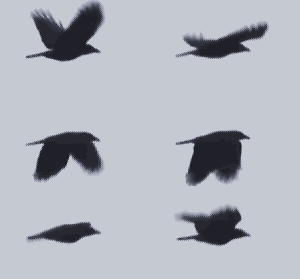
Realistic Appearance: Another major thread in the development of ornithopters is the effort to achieve a more realistic appearance, or a closer approximation of how real birds fly. There is no reason for a manned aircraft to look like a bird. These ornithopters are bird-sized.
 
    
Rubber-Powered Ornithopters: For over 135 years, inventors and hobbyists have been experimenting with ornithopters powered by rubber band. These little ornithopters range from simple to complex, and the story of their development is very interesting.
 
    
Engine-Powered Ornithopters: At one time, we strove to advance beyond rubber power and harness the internal combustion engine. Now we use electric motors for most projects, but early ornithopters built with piston engines laid the foundation for present ornithopter research.
 
    
Large Radio-Controlled Ornithopters: Picking up where the previous story left off, the past several decades have seen great advancement in the design of radio-controlled flapping-wing aircraft. It's important to see what's been done already to provide direction for your own research.
 
    
Micro Air Vehicles: Military interest in using ornithopters for spying has encouraged the development of extremely small ornithopters. Some of these tiny robotic insects carry camera payloads, and they can maneuver in small spaces like inside a building.